Book Review:
Giorgia’s Vision, Giorgia Meloni in Conversation with Alessandro Sallusti
S. Ramkumar
NOV 3 , 2026
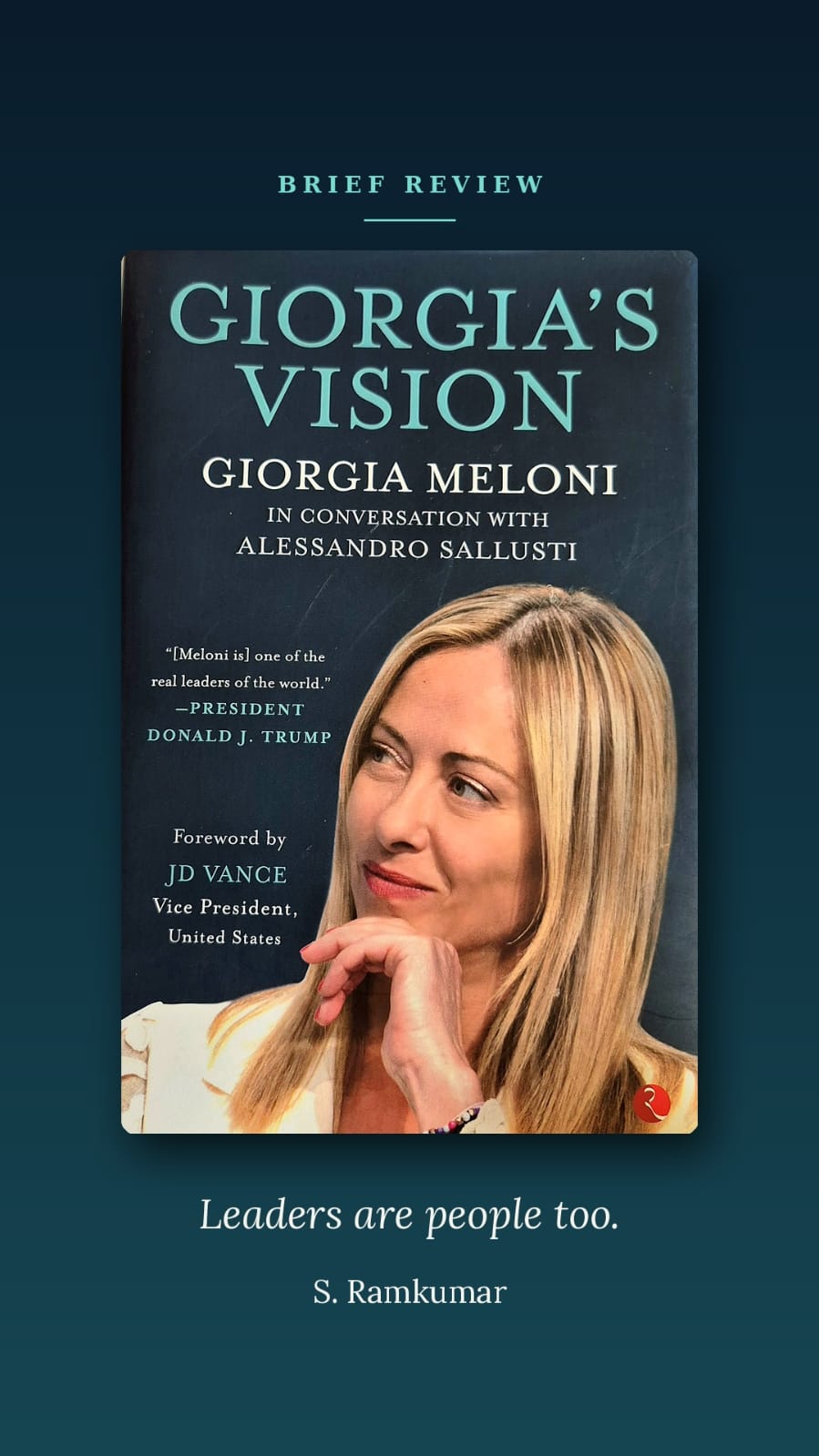
Whatever the party or the country, reading about leaders offers insight into life itself. Their perspectives are shaped by context, time, technology and territory, yet people are much the same everywhere. That is what made Giorgia’s Vision an interesting read for me.
The book is a collection of interviews with Italy’s Prime Minister, with a foreword by J.D. Vance. Its charm lies in its format: short, informal questions, each followed by a precise answer. A reader can dip in anywhere and take away whatever insight suits them.
A few moments stayed with me.
On becoming Prime Minister. Meloni recalls being struck not by how happy people were, but by how emotional. “Why are you all crying? I haven’t even started, and you are already crying!” She understood that her story broke taboos in a country where decisions about people’s lives seemed to be made behind closed doors, and where many felt certain opportunities were beyond their reach.
On trusting people. Asked where we would stand if nothing ever changed, she answers with optimism. She has grown convinced that she can trust the Italian people, and that whenever the right thing is done, they will help make it work.
On the loneliness of leadership. She turns to the French “peasant philosopher” Gustave Thibon: we are free to the extent that we live off what we love, and slaves to the extent that we depend on what we cannot love. Because she loves Italy more than anything except her daughter, she calls herself a free woman, even with the personal sacrifices the office demands.
On vision. Politics without vision, she argues, shrinks to personal interest and blind ambition. When you believe in something, you and your party are merely tools for those ideas. “The only reason we want to reach the top is so that we can look farther afield.”
On the worst day. Sallusti asks which day has been the worst since she became Prime Minister, and her answer is a long and candid one that many readers will relate to. She says there have been many difficult days and that it is hard to single one out. Some days, every ring of the phone brings news that something has gone wrong. But she has learned to live with it.
She then offers what she calls a secret: she has always been a rather pessimistic and anxious person. What surprises her now is her own composure. She hesitates over whether to call it serenity and settles on concentration, the focus with which she is handling this phase of her life. She never expected it, and it is one of the few things about herself she cannot explain. Earlier in her career, when her responsibilities were far fewer, she was much more anxious than she is today.
Her best explanation is the image of an athlete before a big race. The legs wobble beforehand, but once the race begins they know exactly what to do. It is as if her mind concluded that anxiety is “a pointless waste of energy,” and she calls this the only logical answer she has found.
She also describes how she protects that calm. She knows many people are trying to provoke her into losing her temper, and so far they have not succeeded. She hardly reads the newspapers or the commentary, and she does not usually watch television programmes about her. This is not disrespect for journalists, she says, but a wish not to be influenced. Her rule is to do what her conscience tells her to do.
Her answer ends on a more sombre note. Beyond the stressful days, she says, there have been many sad ones: the floods in Ischia and Emilia-Romagna, the Cutro massacre, and the days she lost friends, among them Andrea Augello and Silvio Berlusconi.
On community. Vice President Vance, in his foreword, identifies what he sees as the heart of her vision, a goal that is unmistakable to anyone lucky enough to speak with her: restoring Italy’s “sense of community without which we’ll never be able to express our collective potential.” Meloni recognizes, he writes, that Italy cannot thrive economically until it revitalizes the institutions essential to any nation’s well-being: family, faith and love of country. Without strong families and moral leadership, markets grow fragile and civil institutions brittle. And without a common culture, future generations inherit rootlessness and alienation.
On personal relationships. Another question turns to the personal relationships she builds, which she is known for focusing on. Do the dynamics at the highest levels of politics really differ from those in everyday life? Of course not, she says. What matters is how comfortable people feel with you, and how well you step into their world, understand them, put yourself in their shoes and respond to their needs. Every country has its own history, and almost every leader is trying to do what is best for their people, or at least what sounds best to their public. It is the same for everyone. If you don’t ask what you can do to help others, you can’t expect them to help in return. The key, she insists, is that the relationship must be one of equals.
Giorgia’s Vision will interest any reader, and especially anyone who enjoys politics, whichever country they live in. The principles of politics are remarkably similar everywhere, and a leader’s perspective is most insightful when read against the context she works in. At heart this is a book about the effort to do good, and about the constraints and challenges that come with it: local pressures, and the expected and unexpected global changes that affect a nation. Its simple questions and direct answers feel like they come from the heart rather than the head, so the book reads almost like a story.
Add a Comment