STRANDOMS: the stray and random thoughts
October 20, 2018
Prof. S. Ramkumar
Lifestyle, life
Aladdin’s lamp for the 21st century: the smartie phones
From 18th century Aladdin’s lamp to 21st century smart phones, the travel is from tale to technology. Interestingly, issues that the mobile phones raise in a society is myriad : with many among the world possessing this magic lamp which needs only ‘a’ touch to deliver wishes.
The advent of technology is rapid, revolutionary and unstoppable. As television made the first phase of entry into homes and institutions in India in the 1980s, it slowly started rewriting the potential of information and entertainment to be delivered at home. But it started as a medium of magnet that made family members huddle together to watch programmes. This binding between members slowly dispersed when programmes and soap operas multiplied and the choices of channels increased, taking to present day of cable TV and dish antennae relaying programmes around the globe TVs. As the remote of the TVs were competed for, many homes had more TVs walking in.
The computers in common educational institutions in India became popular in the mid-1990s. The fast pace of its penetration is evident by its ubiquitous presence in institutions and homes, with various updated models (based on memory and speed) and the laptops entering into the social system. Along with them mobile phones and the present smart phones/androids started entering homes. Compared to the PCs and TVs, smart phones turns to be more a personal possession among the members.
The iphone emerged in 2007, with Steve Job declaring at that time that in one device “we will have the world’s best media player, world’s best telephone and world’s best way to get to the web – all three in one”. This might look simple now, but a decade before it was a daring revolutionary techno advancement of bringing the world onto a palm size device. As Friedman (Thank you for being late, 2016) puts it: a whole group of companies emerged in 2007. Together these new companies and innovations have reshaped how people and machines communicate, create, collaborate and think”.
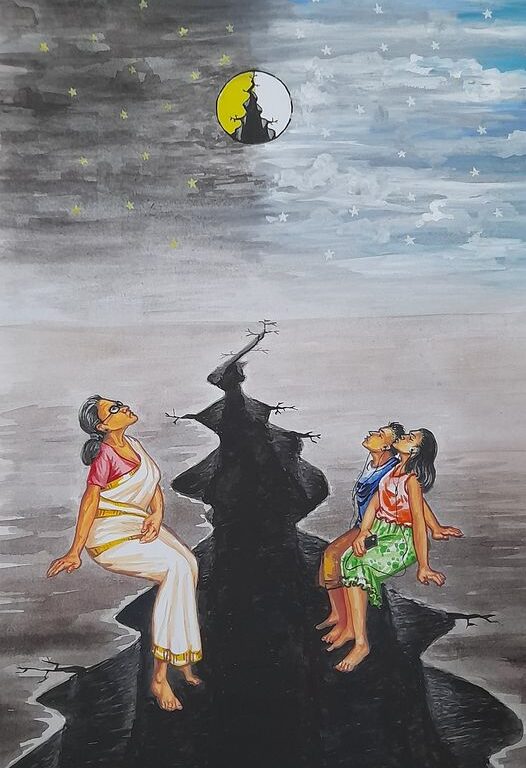
Technology creates tectonic tides on any social fabric, as it can connect people, events, practices, ideas, feelings, emotions and what not, within a short time. The magic lamp of this century- the smart phone – opens with abracadabra (the pass word) and a touch on the phone. There is no need of a ring which Aladdin had to rub on the lamp for a wish. As it delivers the desires at a personal level, great onus is with the people who use this Technology on Palm (ToP) which connects them to their wishes within a flash of a wink. Eric Beinhocker distinguishes the evolution of technologies as “physical technologies”- stones, tools, bullock-drawn ploughs, microchips and the “social technologies”- the rule of law, regulations etc. Both these co evolve. Cutting the discussion short, he suggests that “our physical technologies can get way ahead of the ability of our social technologies to manage them”.
The smart phone thus a physical technology with all its advantages, often creates social stresses too. The sweeping scenario is making the individuals of society to compete the speed of innovations to position their “identity”. We aren’t born with our identity – far from it- but we are born with a range of abilities and tendencies.
(Verhaghe, 2014: What about me? The struggle for identity in a market-based society). Identity is always a construct that derives from an interaction between the identity holder and the wider environment. Its core is formed by a coherent set of norms and values , the larger narrative of a particular culture. When they change, we too evolve in the direction of the new narrative with the new norms and values :Verhaghe, 2014. The smartphone is one of the latest technology that is making roles to reinvent themselves – as father, mother, teacher, brother, friend, teacher, son, daughter, sister, grandparents, …- to fit in new norms and values. This is what I mentioned earlier as “Technology creates tectonic tides on any social fabric, as it can connect people, events, practices, ideas, feelings, emotions and what not, within a short time.” This is a societal re fabrication exercise that’s on. Adapt to the changes, rather than worry on what we have come through and what is now. None can stop the techno tide ; we need to ride it.
A smartphone brings the world, confidence, entertainment and information to the user at his/her will. Aladdin couldn’t have wished more, since he did not know more than what he knew to ask for in the 18nth century. Today the information highway is loaded with traffic for any user irrespective of the age or education of the user. The options they can ask for through a touch on the phone is innumerable.
The wish, the desire and the need has to be carefully looked into before its touched for in the ‘ToP!’ Indiscriminate and innumerable options exists, the ability to discriminate and limit the wishes can change you to the Aladdin with the phone.
To end with an example:
We used to sit at home on the floor, legs crossed few years back and had home cooked food,
then we sat on a stool and ate on a small table or desk- home cooked food,
then we ate on a dining table – home cooked food,
then we ate on dining table the hotel food brought by parents,
then we all ate hotel food delivered by the hotel to home,
now we eat food delivered by the swiggy from hotels to our home, and
now we sink into a couch, eat the Swiggy food, with eyes shared between the TV and the ‘smartie’ in our hand.
The ‘smartie’ leads us to an inward world of personal, amidst the crowd. All need to manage the wishes and connect with the nearby to arrive at their own “Identity”.